
Application
Review the questions and materials you will need to submit your project
This is a view-only version of the application form. To complete the registration and application forms, you must click the purple button in the top right corner of this page.
Thank you for participating in the Henry L. Hillman Foundation’s Powered & Prepared Initiative!
This program seeks to support the purchase of backup power generation and allow organizations in the ten counties of southwestern Pennsylvania to continue to offer essential services to the community during power outages.
We recommend reading all requirements for this application before you begin and encourage you to review the Rules and FAQ, as well as the scoring rubric that will be used to assess all valid applications.
This application form saves automatically and the status of your application is available to view on your dashboard. You have the option to request an automated confirmation email after clicking Submit – be sure the checkbox is clicked to opt into this email when the confirmation message appears.
Your submission will be shared with Evaluation Panel members, the Selection Committee, and the Powered & Prepared Initiative team during the evaluation process. Portions of your applications may be published online and may be shared with the general public to promote your proposal or to highlight results. Those portions may include, but are not limited to: Lead Organization, Lead Organization Website, Project Title, Project Statement, Executive Summary, Video Pitch, and Project Description.
Responses to this submission form must be in English. This provides consistency across all submissions during our review process and reduces the risk of misinterpretation or translation error.
Prior to submission:
- Confirm the information provided on the Registration Form is correct (go to Submissions and select Registration Form).
- Be sure to review your submission as it will appear after it has been submitted (click Preview next to Submit).
- When you have completed all requirements, you will be able to submit the application form. Once you have submitted, you will no longer be able to make changes.
Submit your application no later than 5:00 PM Eastern Time on Thursday, September 17, 2026. Contact us with questions or technical issues.
All fields are required unless otherwise noted.
A. QUICK PITCH
Offer a brief and compelling overview of your project-based proposal. In this section, avoid using first-person language, acronyms, jargon, or complex language that may be difficult for the general public to comprehend. Your responses to this section may be shared publicly in a variety of online settings.
Project Title (up to 10 words)
Provide a title for your project that easily identifies and distinguishes it from others.
Project Statement (up to 25 words)
Provide a short description of your project in one sentence.
Executive Summary (up to 75 words)
Provide a concise summary of the main aspects of your project. This should be a stand-alone statement of the problem and the solution that the project represents.
B. VIDEO PITCH
You are required to submit a video that captures your project and describes why it should be funded. The video is an opportunity to showcase your work and to pitch your project in a succinct format. We want you to share your vision in a way that is different from the written proposal. This DOES NOT need to be a professionally produced video – a video shot on a smartphone is acceptable.
In order to complete this part of your application, upload a short digital film using YouTube. Video submissions must follow these guidelines or else it will render the application ineligible:
- Ninety (90) seconds in length maximum.
- In English, or if in another language, subtitled in English.
- Must be captioned. See information about automatic captioning for YouTube videos here.
- Excludes images of identifiable children (under age 18) without express parental consent.
- Excludes copyrighted material (including, but not limited to, music) for which you do not have a license.
- Set the Privacy Settings on your video to Public or Unlisted – do not set them to Private. When setting as Unlisted, only those with the URL – such as the Powered & Prepared Initiative team, the Evaluation Panel members, and the Selection Committee – will be able to access and view the video.
- Check to make sure embedding is turned on.
- Be sure all these settings are in place throughout the duration of the initiative.
Here are general suggestions for delivering a high-quality video pitch:
- Introduce yourself and your organization(s) or team.
- Explain your project, its impact, and what is unique about the way it addresses the problem.
- Identify how this award will strengthen your capabilities to provide essential services to the community in times of emergency.
- Do not simply read a slide deck – instead, make an effort to connect with your audience of Evaluation Panel judges.
- Make sure your video is well-lit and free of background noise that might make it difficult to hear you.
C. THE TEAM
Provide a basic understanding of the leadership, structure, and capabilities of those working on this project. Should you receive funding, you must designate a Lead Organization responsible for taking accountability for those award funds and any required reporting, as well as providing sustained project direction, control, and supervision. The Lead Organization was identified during registration. If the Lead Organization has changed, please select Registration Form from the Submissions menu to update the Lead Organization information.
Partners
We welcome applications from teams that include multiple organizations and reflect new collaborations of service providers working together in times of emergency. If your team consists of two or more organizations, list them using the legal name of each partner. If your team does not consist of two or more organizations, enter “Not applicable.”
Partner Agreement
An agreement, such as a Memorandum of Understanding (MOU), may be requested from teams consisting of two or more organizations that are responsible for the proposed project and that would receive a portion of funding from the initiative. If your team consists of two or more organizations, indicate the status of your partner agreement below. If your team does not consist of two or more organizations, select “Not applicable.”
- Team of two or more organizations with a fully-executed MOU
- Team of two or more organizations intending to submit an MOU if requested later in the review process
- Not applicable
Team Structure (up to 150 words)
Describe the roles, responsibilities, and contributions of each key team member/partner. Explain how the team will work together, including any reporting structures between the partners and Lead Organization.
Team Biographies (up to 200 words)
Introduce us to at least one and up to three individuals who will oversee and be responsible for the success of the project, including any external partners integral to implementation. For each, provide a first/last name, title, and affiliation (if applicable), and a brief biographical statement. Emphasize the expertise and/or credentials that are most relevant to this project, as well as any personal experience with the challenges the solution aims to address.
Track Record & Capabilities (up to 150 words)
Describe the past success of your team’s leadership, members, and/or collaborators or partners. If relevant, include details about how and why the collaboration was formed. Explain how your team is uniquely positioned with the right capabilities, professional and/or personal experience, technical expertise, and commitment to execute your project. Be sure to include core competencies and how they apply to your project, any relevant past endeavors, experience, or outcomes, and any other additional details that support your ability to deliver results.
D. THE CHALLENGE
Here is your opportunity to more fully explain the specific problem you intend to solve. Your definition of the problem must link directly to the need for backup power generation so that organizations that provide essential services to the community during times of emergency can continue to offer services during power outages.
Challenge Statement (up to 150 words)
Set the stage for your project by illustrating your understanding of the problems you are committed to solving. Describe the regional or community needs your project will address. It is critical that your explanation reflects a genuine and authentic understanding of local conditions.
Local Conditions & Existing Landscape (up to 200 words)
Describe the local conditions in and around where you intend to implement your project. This is your opportunity to showcase that you’ve taken time to understand any issues that are important and/or unique to the local community. Explain how the project is complementary/additive to and not duplicative of existing community efforts, initiatives, and plans.
E. THE PROJECT
The Powered & Prepared Initiative seeks proposals to purchase backup power generation and allow organizations in the ten counties of southwestern Pennsylvania to continue to offer essential services to the community during power outages. Showcase your strategic approach and scope of work. Be sure to emphasize how your solution aligns with the four criteria used to assess each valid application (see scoring rubric).
Project Type
Select the project type that most closely aligns with your proposal.
- Fixed Generator
- Portable Generator
- Solar Power
- Battery System
- Other (please describe under Project Description below)
Project Description (up to 250 words)
Describe your project and how it will effectively sustain essential community services during power outages. Provide an overview of key stakeholders and introduce the measurable impact and benefits to these populations. Note: Later in the application you will have additional opportunities to describe stakeholders, beneficiaries, and intended impact in more detail.
Integration (up to 250 words)
Further illustrate your understanding of the local environment where you have chosen to implement your project, including currently relevant systems and local conditions which affect your plans. Address issues that might concern stakeholders, such as cost efficiency, functionality, and long-term maintenance. Explain how you’ll build upon and integrate within existing systems and infrastructure, as well as how your project could be used as a model for other essential service providers in your local community.
Emergency Plan (up to 250 words)
Detail your emergency plan and outline steps for continuity of operations on-site or at a secondary location during loss of power. If applicable, include information on starting/supervising backup power generation. Review the planning guide under Resources for additional information.
Project Visual (up to three pages)
Upload a single PDF that includes a visual representation of your project. At least one element of this visual must include a photo of the project site. Other visuals may include, but are not limited to renderings, images, illustrations, schematics, graphs, diagrams, maps, or other visuals to help reviewers to better understand your team and proposed project. The PDF should not exceed 10MB and a total of three pages, and should not contain additional text explanations or be used to circumvent word counts in this application. Some brief labels and/or basic text descriptions are permitted. Any pages beyond the three-page limit, as well as unrelated content to this specific question, will render the application ineligible.
F. STAKEHOLDERS
Tell us more about where your proposal will focus its impact and the stakeholders that will benefit.
Beneficiary Description (up to 200 words)
Describe the people, communities, and geographies that your project is intended to benefit. Explain your priority beneficiary(ies), as well as any secondary or other populations who may engage with and/or benefit from the proposal. Describe your approach to responding to existing and expected needs of these populations.
Stakeholder Engagement (up to 200 words)
To be effective, projects will need support or partnership from others – community leaders, local government entities, etc. Demonstrate your understanding of the key stakeholders necessary for your work to be effective and describe plans to engage them on an ongoing basis to ensure long-term success. Articulate any costs/burdens that stakeholders may be expected to absorb.
Underserved Populations & Accessibility (up to 150 words)
We expect teams to be strategic about working with a range of stakeholders and beneficiaries, and to actively plan for and include the most marginalized or vulnerable residents in project design, planning, and ongoing work. Explain how you will ensure that the design and implementation of your project authentically embraces accessibility and belonging across all populations.
G. THE IMPACT
Demonstrate how your project will achieve success, including evidence that supports your approach.
Metrics & Results (up to 250 words)
Identify all goals, specific metrics, and/or objectives to implement your project within the maximum two-year project period. Describe your methodology for measuring the overall performance of the proposed strategy and outline the means through which you will track results or milestones to indicate success.
Long-term Operations (up to 200 words)
Provide a clear plan for the long-term maintenance and operations required after project completion and beyond the maximum two-year project period, as well as how it will be funded and who will perform these activities. Describe how the system will be properly maintained to manufacturer specifications.
Evidence of Effectiveness (up to 200 words)
Provide evidence to show that the project will be effective and share reasons why your results could be replicated or scaled to improve power resiliency in other contexts. Present any internal (e.g., informal studies, observations, or other indicators of change) or formal evidence, including any results from complementary or previous initiatives.
References (up to 150 words)
If you included citations [#s] in the Evidence of Effectiveness section, provide a bibliography with a corresponding bracketed number [#] for each citation. If you do not have citations, offer a list of resources that may be used to validate general claims made in your application. You may link to articles that may be accessed online. We do not enforce any particular format for this bibliography. It is your responsibility to make citations easy to understand. If not applicable, enter NOT APPLICABLE.
Communications (up to 150 words)
Briefly describe your plans to promote your project and/or share your results, key findings, lessons learned, and other helpful information with others. Explain how your project could be replicated, adapted, or scaled by other essential service providers.
H. PROJECT PLAN & BUDGET
Illustrate your plan and the resources required to successfully implement your project.
Plan & Timeline Narrative (up to 250 words)
Offer a general overview of your implementation plan over the course of a maximum two-year project period. Include quarterly or monthly key activities and milestones to help track and measure success.
Project Quotes (150 words)
Provide the information from two to three pricing quotes for key components of the proposed project. This may include equipment, supplies, contractors, labor, and more.
Budget Narrative (150 words)
Offer a general overview of how you will use the $300,000 award, including projected needs by category. You may include any explanations of existing resources you have already secured.
Detailed Budget
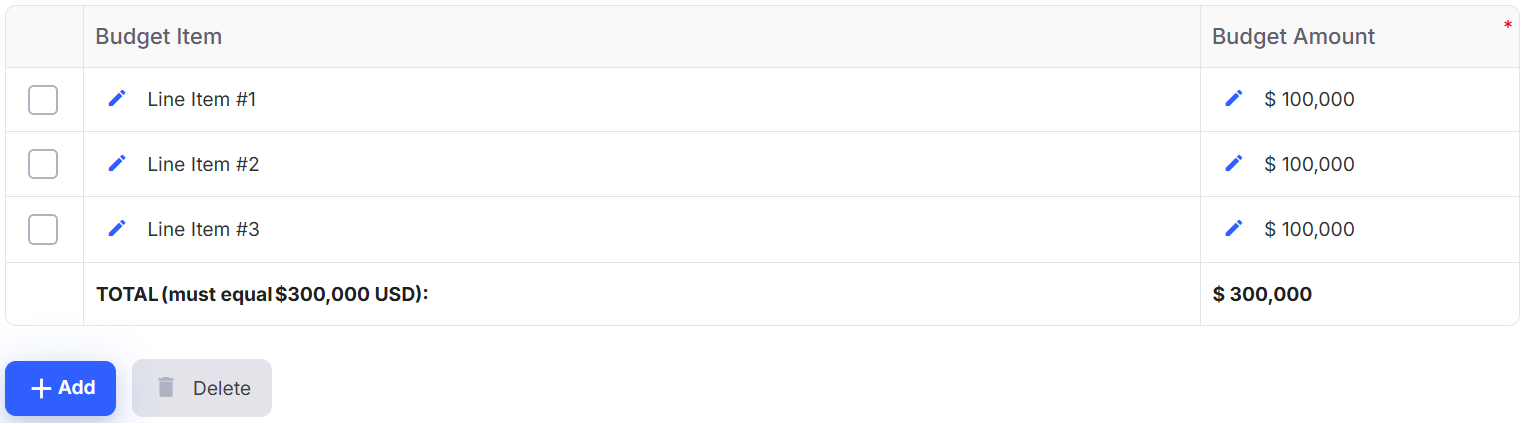
Provide a detailed budget for how the $300,000 award would be spent. Funds identified in this table should reflect and clarify your general explanations provided in Budget Narrative above and include more detailed cost categories that support your plans and intended outcomes. Avoid any general line-item descriptions such as “Miscellaneous.”
Awards may be used to pay for equipment and installation costs as well as relevant electrical and enabling renovations. Eligible expenses include, but are not limited to, equipment and supplies, installation costs, enabling renovations and upgrades, salaries for directly relevant personnel, and seeding small maintenance and repair funds.
While general operating support is not allowed, applicants may have overhead costs that are not directly attributable to the proposed project but are necessary for implementation. We reserve the right to review and adjust the amounts allocated for indirect expenses. We will consider paying for these indirect costs up to a maximum of 10% of direct project or activity costs.
Ensure that any indirect costs are accounted for in your budget in the application. Any portion of salaries and other similar costs that will be allocated directly to implementation of the proposed solution are eligible expenses and can be their own line items. Review the Rules for more information about the use of award funds.
The budget must account for the full $300,000 award.
Total Projected Costs
Provide the estimated total costs (in US dollars) to successfully implement your proposed solution over a maximum two-year period. The total projected costs may be more than the $300,000 award.
Resources & Contingencies (up to 200 words)
If your project may require more than $300,000 (USD), explain your contingency plan and/or how you have secured (or plan to secure) the balance of any necessary funds. Be sure to provide an overview of how those funds will be used. If you do not expect your total projected costs to exceed $300,000 (USD), enter “Not applicable.”
Other Funders (up to 75 words)
List other key funders and amount of funding secured to date for the proposed solution, including in-kind support. If there are no current commitments for the solution, enter “Not applicable.”
Risk Mitigation (up to 100 words)
Explain how you will ensure your project is feasible. Describe the main risks your proposal could fail, as well as any unintended consequences, and your plan to address them. Discuss your experience and capacity to manage technical and/or operational barriers.
Other Considerations (up to 100 words)
This is your opportunity to raise any other considerations, emphasize or expand upon a previous point, or provide new information, as necessary. Note: Evaluation Panel judges are instructed to avoid online research and/or review of links that may be provided as part of this submission – we recommend you include any key considerations and important information within your responses to this application form.
I. ADMINISTRATIVE INFORMATION
Provide additional information about the Lead Organization.
Lead Organization Identification Number (up to 5 words)
Provide the identification number provided by the Lead Organization’s taxing authority (e.g., the Internal Revenue Service). If this is in progress, insert “Pending approval.”
Annual Operating Budget
What is the annual operating budget (USD) of the Lead Organization?
- Less than $500,000
- $500,001 to $1 Million
- $1.1 to 5.0 Million
- $5.1 to 10 Million
- $10.1 to 25 Million
- $25.1 to 50 Million
- $50.1 to 100 Million
- $100.1 to 250 Million
- $250.1 to 500 Million
- $500.1 to 750 Million
- $750.1 Million to $1 Billion
- $1 Billion +
J. ADDITIONAL INFORMATION
If your team is invited to participate in any future phases of this initiative, you may be required to provide additional information, including but not limited to:
- Your acceptance of a separate award agreement with the Henry L. Hillman Foundation. NOTE: The linked agreement is provided as an example only. Each grant agreement governing the use of Awards may vary, depending on the nature of the project, the organization receiving the Award, and the Henry L. Hillman Foundation.
- A more detailed budget, project plan, timeline, and/or evaluation plan
- Site maps, photographs, diagrams, and other information further describing project
- Fully executed Memorandum of Understanding (MOU) with any partners
- In-person site visit to view where the project will be implemented
- Tax determination letter, if applicable
- Audited financial statements, 990s, and/or certified financials
- Current balance sheet and/or current statement of operations
- Board of Directors membership and executive leadership list
- Articles of Incorporation, Charter, or similar documentation
- Evidence of efficacy of the solution, including technical capabilities if applicable
- Evidence of additional funding and resources secured to implement the proposed project
- Existing policies, if any, addressing conflicts of interest, whistleblower, internal controls, anti-money laundering, intellectual property, code of conduct, ethics, gifts, and any similar policies governing the Lead Organization and/or partners
The Powered & Prepared Initiative Team reserves the right to perform background checks on key individuals associated with the project, and the refusal by the key individuals to provide necessary authorizations will give reason to reject any application for further consideration. Background information and the results of any background checks will be kept confidential.